
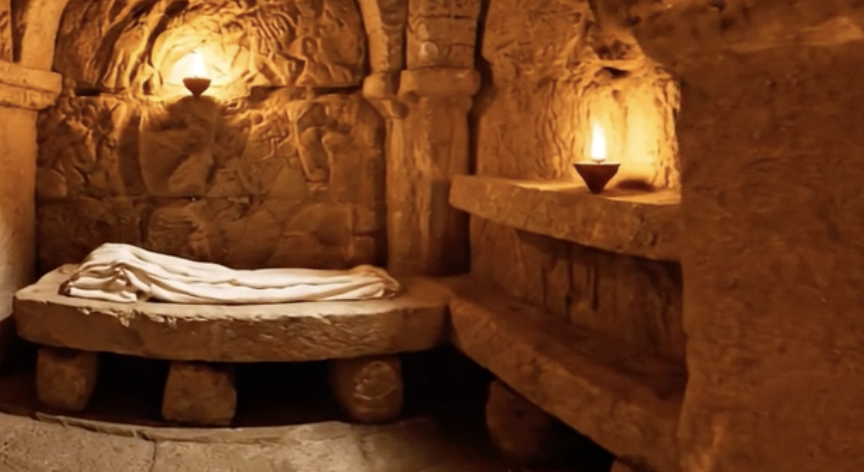
In the sixteenth century, John Calvin took one look at the Gospel of John and declared the Shroud of Turin a fraud—not because he had examined the cloth, but because the evangelist used the plural word othonia, “linen cloths.” For Calvin, that single grammatical detail was enough to dismiss the idea that Jesus had been wrapped in one great shroud with an image burned into its fibers.2 Yet the irony is striking: Calvin’s objection, meant to close the case, actually opens a fascinating doorway into the world of first‑century Jewish burial customs, the language of the New Testament, and the mysterious scene that caused the beloved disciple to “see and believe.” This paper steps through that doorway and asks a simple question: what if Calvin’s linguistic argument was built on a misunderstanding—and what if othonia points not away from the Shroud, but directly toward it?1
“Othonia” and the moment John “saw and believed”
The name Othonia comes from the Greek ὀθόνια (othonia), the word John and Luke use for the burial linens associated with Jesus’ burial and the empty tomb (John 19:40; John 20:5–7; Luke 24:12). Within the context of the Fourth Gospel, the term othonia would have been instantly recognized as referring to linen burial cloths. This understanding is supported by three interconnected factors: the word’s linguistic background, Jewish burial customs during that era, and findings from archaeological sites in first-century Judea.
More than “linen strips”
A common misunderstanding is that othonia means narrow “strips,” as if Jesus were wrapped mummy‑style. But othonia is the diminutive plural of ὀθόνη (othonē), a term that in classical, Hellenistic, and Koine Greek consistently denotes a large linen sheet—the same word used in Acts 10 for the great sheet lowered from heaven in Peter’s vision. Greek authors do not use othonē or othonia for wool, goat hair, or mixed textiles; when they mean wool, they employ entirely different vocabulary. Lexically, the default meaning of othonia is “linen cloths,” not bandages.2
This is why New Testament philologist Frederick Danker expressed doubt that othonia in the New Testament should be understood as mummy-style strips or bandages.3 That judgment aligns with the way major English translations render the term as “linen cloths” or “linen wrappings,” often with notes cautioning against the idea of narrow strips.
Jewish burial custom and linen
John reinforces the material expectation in John 19:40, stating that Jesus was wrapped “in othonia … according to Jewish burial custom.” That phrase is not ornamental. It signals that the burial followed established Jewish practice, which carried clear material assumptions.
In Jewish burial custom of the period, linen was preferred for the dead. Wool was generally avoided because of purity concerns, while linen was associated with ritual cleanliness and dignity. Rabbinic sources such as Semahot 12 and Mishnah Shabbat 23 reflect this expectation, as does the broader cultural witness of writers like Josephus. Within this framework, a burial carried out “according to Jewish custom” would be assumed to involve linen cloths. For John’s audience, this expectation would have been so standard that the mention of othonia naturally signaled linen burial cloths without further explanation
Archaeological confirmation
The archaeological record confirms what the texts suggest. Burial textiles recovered from first-century Judea, including those from the so-called Cave of the Shroud at Akeldama, are linen tabby-weave fabrics, sometimes with simple finishing or edging. These finds correspond closely to what John’s audience would have assumed without explanation.
Even auxiliary burial cloths, such as ties, bands, or face coverings, are typically linen and often cut from the same bolt of fabric as the main shroud. Nothing in the archaeological evidence suggests an expectation of mixed materials or wool for Jewish burials of this period.
The Lazarus narrative as a control
John’s own Gospel provides an internal comparison. In the Lazarus narrative, John uses the term κείρια (keiria) for the binding strips (John 11:44). The distinction there is functional, not material. Keiria describes strips used for binding, while othonia refers to the burial ensemble as a whole. In both cases, the underlying material is still presumed to be linen. John varies vocabulary based on function, not fabric.5 The evangelist almost certainly intended his readers to recall the Lazarus scene—especially the command “Unbind him!”—as a narrative foil to the Resurrection, where no such unbinding is needed because the linens
remain intact while the body is gone.
Why the cloths matter in John 20
John’s resurrection account is unusually specific about what Peter and “the other disciple” saw:
- The othonia were “lying there” (John 20:5–6).
- The face cloth (soudarion) was separate and described as rolled up or folded in its own place (John 20:7).
The NET Bible notes that John 20:7 is debated precisely because it describes an arrangement of burial cloths, not a random heap. This detail matters only if the cloths themselves are recognizable, intact burial linens.
That observation leads directly into the line John highlights: “he saw and believed” (John 20:8).
What made John believe
John’s point is that the tomb scene did not resemble grave robbery or a hurried removal of a body. If the body had been stolen, the most likely outcomes would have been either the cloths taken along with it or the cloths left behind in disorder. Instead, John records linen burial cloths still present, with a clear distinction between the main burial linens and the face cloth.
Many scholars note that John 20 presents a progression of “seeing” that moves from simple observation to understanding, culminating in belief at verse 8. The linen othonia, arranged rather than discarded, form part of the evidence that makes belief reasonable even before the disciples fully understand the Scriptures (John 20:9). A complementary study of John’s use of “lying” shows that the evangelist intends the linens to be understood as lying exactly as they had been laid on the eve of Passover; it is this continuity of the burial ensemble, now mysteriously vacated, that renders the scene intelligible and enables the beloved disciple to “see and believe.” The linens are still “bound” or “tied” (19:40), but the body is no longer present.4
Why this connects to the name “Othonia”
Othonia is not just a Greek word for cloth. In John’s narrative, the othonia function as evidence inside the tomb. Lexically, culturally, and archaeologically, they would have been understood as linen burial cloths. Their presence and condition bridge the gap between an empty tomb and a concrete conclusion: Jesus is not simply missing. Something happened that John could recognize as meaningful, resulting in faith.
Footnotes
- John Calvin, A Treatise on Relics, trans. Henry Beveridge (Edinburgh: Calvin Translation Society, 1844), 238. Calvin argues against the Shroud’s authenticity on linguistic grounds, claiming that John’s use of the plural othonia (“linen cloths”) in John 20:5–7 excludes the possibility of a single burial shroud.
- While othonia is morphologically a diminutive plural, diminutives in Koine Greek often lose any implication of smallness; here the form functions as a collective plural meaning simply “linen cloths,” not narrow strips or bandages.
- Frederick W. Danker cautions against reading othonia as narrow bandages or mummy-style wrappings. In his revision of Bauer’s lexicon, he notes that othonia refers generally to linen cloths and does not require the sense of strips or bandages. See Frederick W. Danker, ed., A Greek-English Lexicon of the New Testament and Other Early Christian Literature, 3rd ed. (Chicago: University of Chicago Press, 2000), s.v. “ὀθόνιον.”
- For a detailed argument that John’s repeated use of “lying” signals the continued, undisturbed state of the burial linens—and that this linguistic pattern is central to the narrative logic of John 20—see Larry Stalley, “‘He Saw the Linen Wrappings Lying There…’ What is the meaning of ‘lying’?,” Academia.edu, accessed February 12, 2026, https://www.academia.edu/124785677/_He_Saw_the_Linen_Wrappings_Lying_There_What_is_the_meaning_of_lying_2024_.
- consistent with the meaning of othonia in John 19–20. See Orit Shamir and Esther Eshel, “Textiles from the ‘Cave of the Shroud’ in the Hinnom Valley, Jerusalem,” Israel Exploration Journal 55, no. 1 (2005): 66–77.
Bibliography
Primary and Secondary Sources
Beveridge, Henry, trans. A Treatise on Relics by John Calvin. Edinburgh: Calvin Translation
Society, 1844.
Danker, Frederick W., ed. A Greek-English Lexicon of the New Testament and Other Early
Christian Literature. 3rd ed. Chicago: University of Chicago Press, 2000.
Fulbright, Diana. “A Clean Cloth: What Greek Word Usage Tells Us about the Burial
Wrappings of Jesus.” Shroud of Turin Center, Richmond, VA, 2005.
Shamir, Orit, and Esther Eshel. “Textiles from the ‘Cave of the Shroud’ in the Hinnom
Valley, Jerusalem.” Israel Exploration Journal 55, no. 1 (2005): 66–77.
Stalley, Larry. “‘He Saw the Linen Wrappings Lying There…’ What Is the Meaning of
‘Lying’?” Academia.edu. Accessed February 12, 2026.
https://www.academia.edu/124785677/He_Saw_the_Linen_Wrappings_Lying_The re_What_is_the_meaning_of_lying_2024 (academia.edu in Bing
Written by Larry Stalley and Othonia.
On Academia.edu readers can find more than twenty papers Larry has written on the Shroud in the New Testament, such as Why the Image on the Shroud is “the Sign of Jonah” and Hidden in Plain Sight: The Image-Bearing Shroud in the New Testament.
URL: independent.academia.edu/LARRYSTALLEY
This article was written with the assistance of AI. For additional studies by the author concerning the
Shroud, L. Stalley, see his collection of papers at https://independent.academia.edu/LARRYSTALLEY
(independent.academia.edu in Bing).