
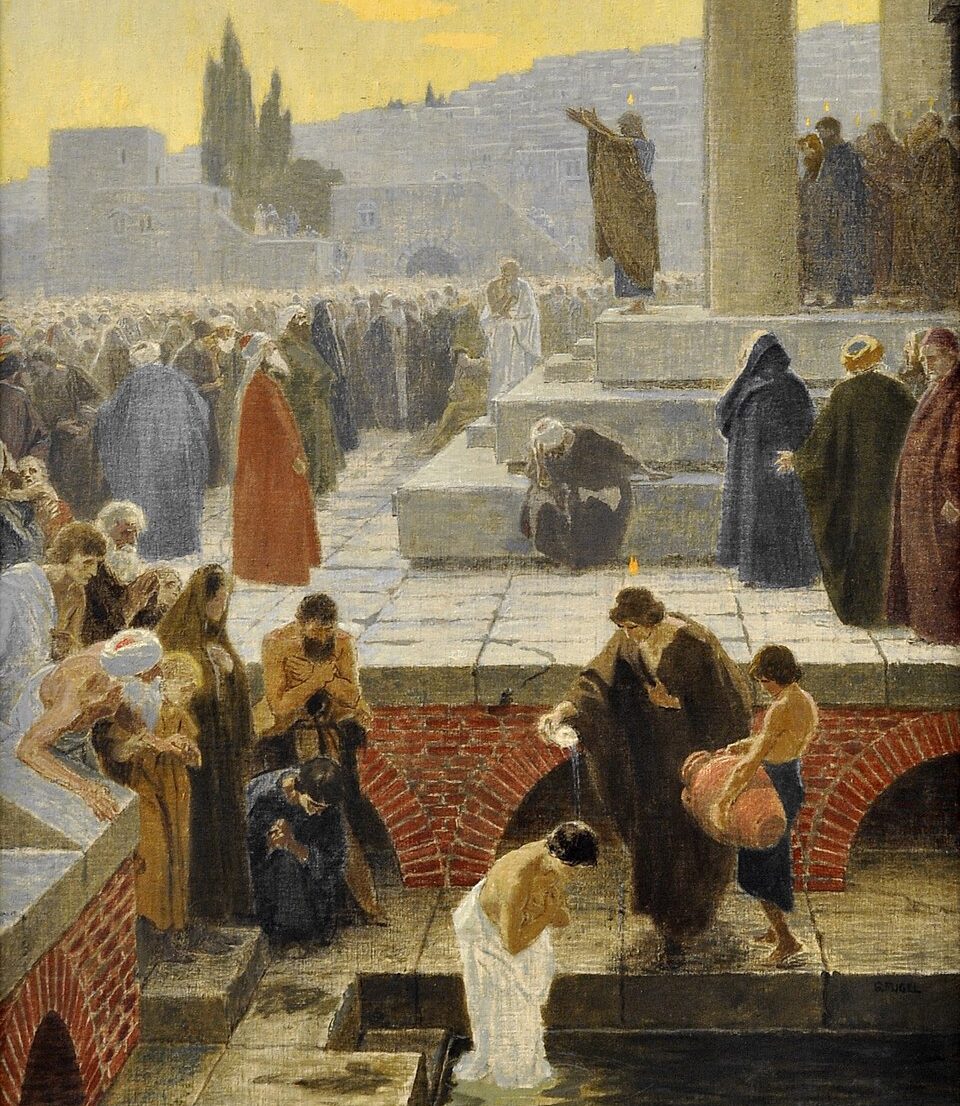
For the Solemnity of Pentecost
In their breathtaking constitution on the Church in the modern world, the fathers of the Second Vatican Council declared that the “joys and the hopes, the griefs and the anxieties of the men of this age… are the joys and hopes, the griefs and anxieties of the followers of Christ” (Gaudium et Spes 1).
The council fathers saw, and indeed sought to show before “the whole of humanity” (GS 2) that Christ and His people were not at all a threat to the world’s flourishing or its pursuit of happiness, but indeed were the “sign and instrument” of all of these — the source of their most radiant and lasting fulfillment.
In the life of our wounded world we see the selves we once were before having been adopted as heirs into the glory of the cross and resurrection. We see in our brethren that hollow, suffering despair that so silently plagues vast multitudes of our fallen civilization, making itself visible in the billions of hours of soon-forgotten scrolling, in modern man’s hopes for a life & a freedom beyond his mortal frame, in his aches for a significance that might at last befit the dignity which he rightly recognizes in his own existence.
And to these cries for permanence, to these anguished attempts for an unrestrained, autonomous self-creation and even self-redemption, might we, those standing already upon the great stage of divine inheritance, have something so joyous, so glorious to declare to our world — a world ultimately clamoring for the new paradise we partake of in the eucharistic life of our Lord?
Might we open wide the gates of our minds & hearts, and indeed beckon those of our friends as well, to the liberating sanctity and the glorious destiny which Christ presents before our gaze at every mass?
Nearly 2000 years ago, in that upper room in Jerusalem erupted not merely an energized but a re-created humanity, their being now filled with the very life of God. The invisible, everlasting Kingdom which Christ once announced was “at hand” now burst into his people’s vision, filling their being and raising them into all that they were and all that they could be, a new Eden being birthed from within the now mysteriously-present eschaton.
Ever more before the memory of these transformed friends was Christ’s descent into death’s darkness on the summit of that hallowed hill, that moment where the source of all life entered into the very silent space of all of man’s brokenness, all of his despair, and all of his aches and pains.
And when He emerged, as he rose up from the chasm of all of man’s miseries, forever victorious over the ancient serpent and all his minions, he seems to have left for us an unmistakable echo, a most luminous icon of his tremendous journey.
In that striking linen-captured image, it seems Christ has indeed provided for all the men and women of our day a portrait of Himself at the climax of history. In the wounds of the man of the shroud we see the One who has shared in all of our griefs and anxieties and in His luminous glory has elevated into all newness our now-triumphant joys and hopes.
Indeed, in that upper room, the same Holy Spirit whose power once illuminated the Redeemer’s darkened tomb now poured out as fire from heaven upon ordinary men and women, in time propelling them and those who would succeed them to the ends of the earth, beckoning those they met to open wide their hearts to the “the light that shines in the darkness,” a light which indeed the darkness has not and will never overcome.
May He do the same for us today.