
Researchers combine high-resolution image analysis with physical experimentation to investigate previously unexplained patterns on the ancient cloth
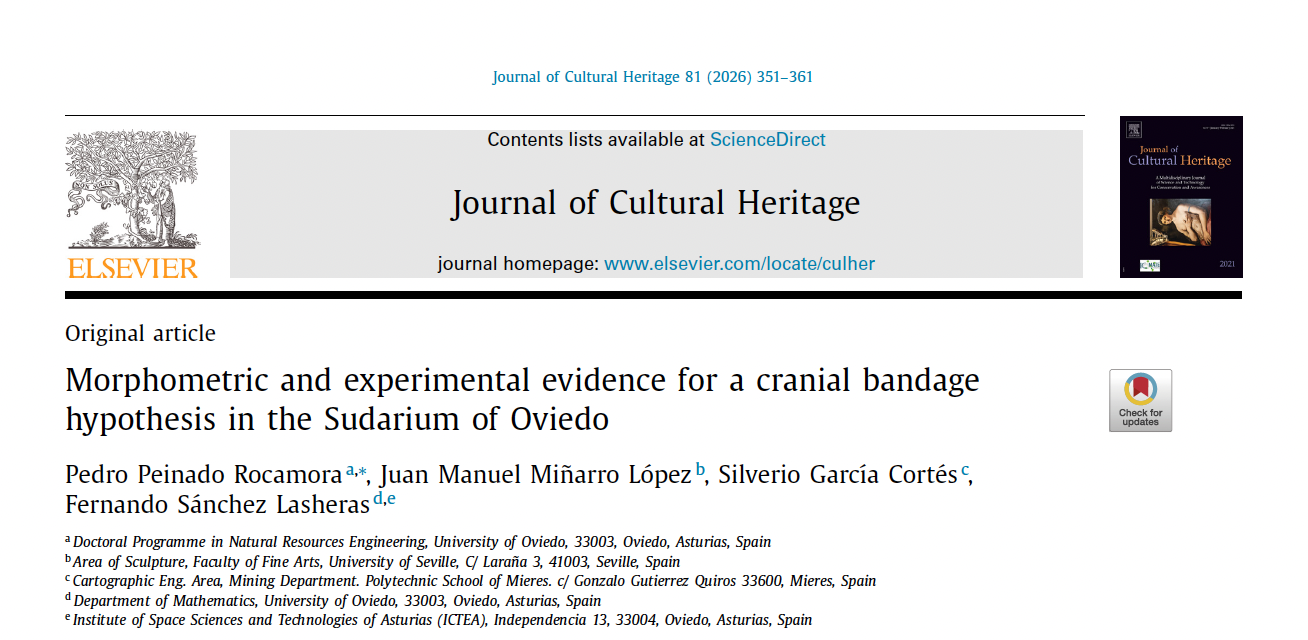
Writing in the Journal of Cultural Heritage, researchers Pedro Peinado Rocamora, Juan Manuel Miñarro López, Silverio García Cortés, and Fernando Sánchez Lasheras investigated whether a bandage wrapped around the head could have held the Sudarium in place while also influencing the way blood and other fluids moved across the cloth.
Their conclusion is careful but significant: the patterns observed on the Sudarium are consistent with a cloth that was held against a head under sustained external pressure, and laboratory experiments showed that cranial bandaging can produce remarkably similar types of patterns.
The study does not claim to prove that a bandage was definitively used. Instead, it presents the bandage hypothesis as a mechanically plausible and experimentally reproducible explanation for several features of the cloth that have been difficult to account for by gravity, ordinary folding, or random fluid movement alone.
Looking Beyond the Visible Bloodstains
Much previous research on the Sudarium has focused on its bloodstains, their anatomical position, and the possible movements of the body while the cloth was in place.
This new study asks a different question:
What held the cloth against the head?
The researchers focused on a series of subtle linear structures and concentrated areas visible on the cloth.
Using high-resolution scans of both sides of the Sudarium, they developed a digital image-processing method to examine variations in intensity that can be difficult to distinguish with the eye alone.
The team identified two principal types of features:
- Linearity patterns, or LPs: quasi-linear traces that cross the normal direction of the linen weave without distorting it. The researchers interpret these as possible traces of externally applied pressure.
- Accumulation points, or APs: localized areas where blood-related material appears to have pooled or concentrated, often in association with the linear patterns.
Importantly, the researchers distinguish the two. The linear patterns themselves are not described as bloodstains. Rather, they may record wrinkles or contact corridors created when pressure was applied to the cloth. Blood accumulated at particular points along that pressure system.
Turning the Sudarium Into a Measurable Map
To investigate these features objectively, the researchers processed high-resolution scans of the Sudarium using a reproducible computational workflow.
They smoothed image noise while preserving edges, separated areas of different intensity, created heat maps, and then generated dozens of isolines, similar in principle to contour lines on a topographic map.
Instead of showing elevation, these lines trace areas of equal image intensity.
This allowed the researchers to ask whether apparently linear features remained visible when the image was processed at different thresholds. Several did.
Some of the strongest patterns occurred in anatomically plausible locations across the frontal and suboccipital regions of the head.
The weave beneath these traces also remained orthogonal. In other words, the linen itself had not been pulled into a structural fold that would easily explain the lines.
The researchers therefore considered sustained external pressure as a possible cause.
Then They Tried to Reproduce It
The study did not stop with digital analysis.
The team constructed a physical experiment using an anatomical head model, linen, bandages, and an artificial blood-like fluid warmed to approximately body temperature.
They placed the cloth over the face and secured it using bandages arranged in configurations running around the forehead, back of the head, and jaw.
They then introduced the fluid through the nasal and oral areas while moving the model through positions intended to reproduce a previously proposed sequence for the formation of the Sudarium’s stains.
The researchers first held the head upright and then moved it into a right lateral prone position, continuing the controlled application of fluid.
What appeared on the experimental cloth was especially interesting.
The bandages created linear corridors of pressure, while fluid became concentrated at endpoints, changes in slope, and places where separate flows converged.
These experimental features resembled the relationship between the linear patterns and accumulation points identified on the Sudarium itself.
The study describes this as a process of generation, transfer, and fixation:
- External pressure establishes preferential pathways.
- The shape of the head influences those pathways.
- Blood or fluid travels within that constrained environment.
- The textile records both the trajectories and areas where fluid accumulates.
Why a Bandage?
A bandage would have served a practical purpose.
The researchers note that post-mortem jaw stabilization and cranial wrapping have been documented in funerary practices across different ancient cultures. A bandage passing beneath the jaw and around the head can maintain upward pressure and keep the mouth closed.
Their proposed reconstruction goes further, suggesting that wrapping could also have helped hold the Sudarium continuously against the face and head during the handling or movement of the body.
That sustained contact could help explain why the cloth records organized patterns rather than evidence of extensive rubbing or displacement.
The researchers also consider a previously proposed alternative: that the Sudarium may have been attached using stitches or threads anchored to the hair and beard.
They do not rule that possibility out.
In fact, they specifically note that stitching and bandaging need not be mutually exclusive. Threads could potentially have helped position the cloth initially, while a bandage supplied the sustained compression needed to keep it securely against the head.
Future experiments could test such a combined system.
What the Study Does, and Does Not, Establish
The authors are explicit about the limits of their findings.
Their experiment used a simplified anatomical model without hair, and the experimental linen was lighter and less densely woven than the original Sudarium. The study also calls for future work involving larger experimental series, models with hair and beard, more quantitative criteria, and direct tests of competing explanations.
Most importantly, the researchers state that their results do not conclusively establish cranial bandaging as the historical mechanism that produced the marks on the Sudarium.
What they have demonstrated is narrower and scientifically useful: when a cloth is held against a head using external bandages under experimentally controlled conditions, the resulting linear pressure traces and fluid accumulation points can reproduce important characteristics found on the Sudarium.
The paper therefore moves the discussion from a proposed visual interpretation toward a hypothesis that can be experimentally tested, challenged, and refined.
A New Tool for Studying an Ancient Cloth
There is another important aspect of the research.
The digital analysis developed for the study is reproducible. The authors have publicly released the image-processing code used in the analysis, allowing other researchers to evaluate or build upon the method.
Because it relies primarily on high-resolution imaging rather than destructive sampling, the approach could also have applications beyond the Sudarium in the study of ancient textiles where conservation restrictions limit physical testing.
For the Sudarium of Oviedo, the immediate contribution is more focused.
The study provides new evidence that some of the cloth’s unusual linear traces and blood accumulation patterns may preserve information about how the cloth was physically secured to the head it once covered.
Nearly every mark on an ancient textile presents a question: Is it original? Was it produced by the textile itself? Did it result from centuries of handling? Or does it preserve evidence of the event in which the cloth was used?
This new research gives investigators another experimentally testable way to begin answering those questions.
Read the Research!
Pedro Peinado Rocamora, Juan Manuel Miñarro López, Silverio García Cortés, and Fernando Sánchez Lasheras, “Morphometric and experimental evidence for a cranial bandage hypothesis in the Sudarium of Oviedo,” Journal of Cultural Heritage 81 (2026): 351–361.
DOI: 10.1016/j.culher.2026.08.002
The article is published open access under a CC BY-NC license.